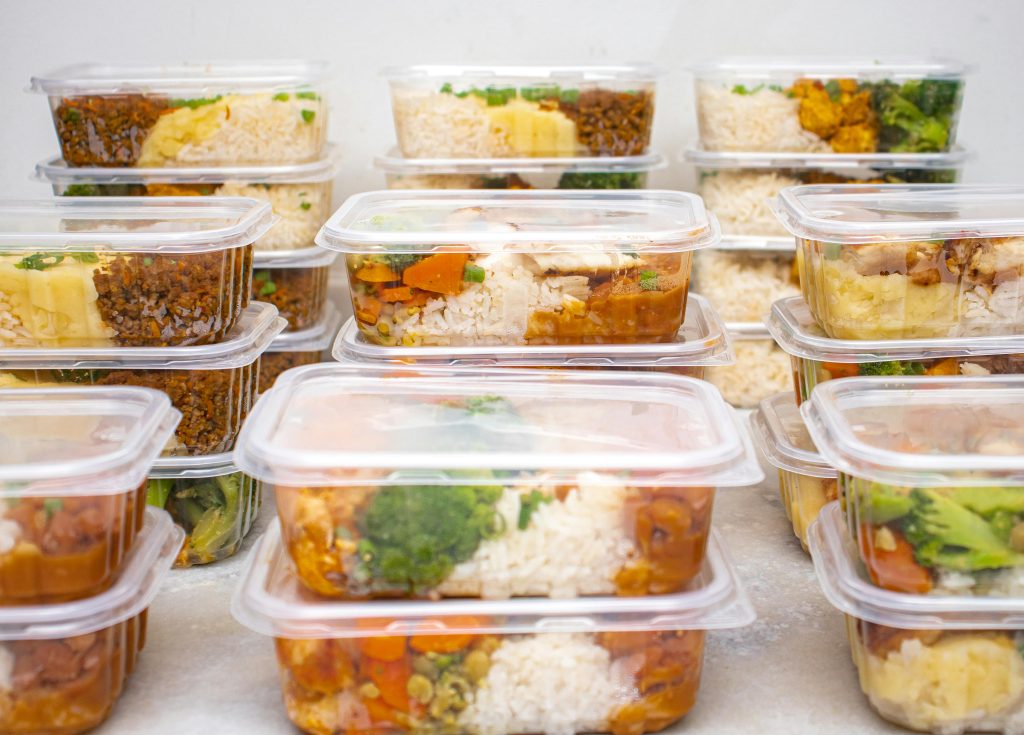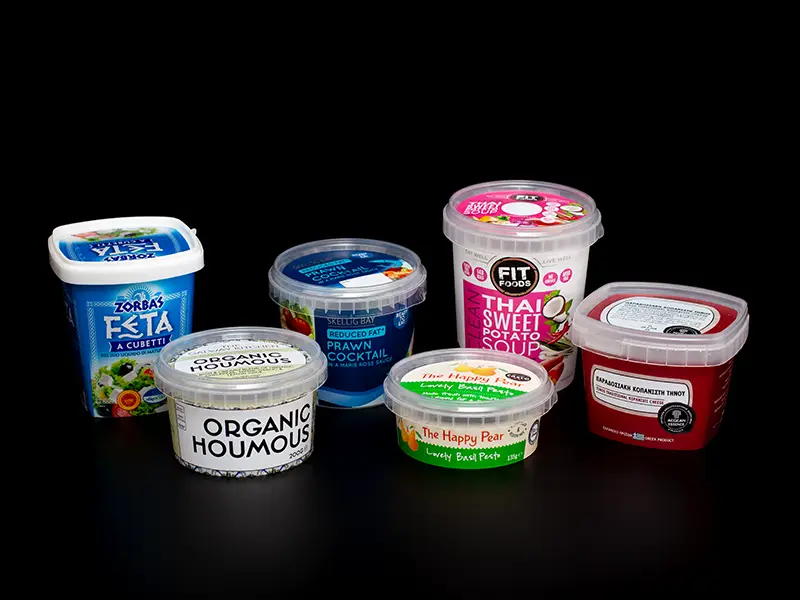
Consumers have a wealth of choice when they are food shopping. The freezers are stacked deep, the chiller units are packed, and there is even a huge range of different food brands to choose from. If your labelling or branding isn’t up to the same level, then a shopper’s first impression of the food won’t match the quality of the product you’ve spent years perfecting.
In-mould labelling is a cost-effective and proven way to ensure your brand stands out in any retail space. You can achieve a high-quality finish during the production process, without additional costs in transportation to other vendors. This guide explains why in-mould labelling is a great option for any size of food producer and how Venturepak can help create a premium package for your products.
If you would like to know more about our In Mould Labelling, click here
What is in mould labelling?
In-mould labelling is a process where a pre-designed, pre-printed label is added to the mould before we form the container. As the plastic goes through injection moulding , it bonds the label permanently to the surface of the container rather than being applied afterwards. This means you receive an integrated package, rather than a label stuck on top.
The flush finish from the moulding process means there are no edges to catch and ensures your brand still looks premium after the item has been delivered and stacked on the fridge shelf or in the freezer. Labelling that is fused to the packaging is also more robust, so consumers rummaging around won’t dislodge any branding from your product.
How does IML compare to other labelling methods?
Other methods of labelling food packaging should be compared before deciding on IML, including shrink sleeves and self-adhesive labelling.
In-Mould Labels vs Self-Adhesive labelling
Self-adhesive labels are a very low-cost but higher-risk approach to branding plastic packaging. A self-adhesive label is added to the container after it has been formed. The downside of this method is the risk of the labels being scuffed, damaged, knocked off or becoming unreadable during transit or when in the retail space. In-mould labelling is a more reliable option, as long as your production run is regular or high-volume; if you are prototyping or planning a very small run of stock, then self-adhesives will prove more cost-effective.
Choose IML over self-adhesives when your production run is constant or medium- to high-volume, or if you require a premium look or robust protection for your products.
Speak to our team, and we can help you choose the right labelling method for your package.
Shrink Sleeves or IML?
Shrink sleeves are plastic film labels that are applied with heat to the packaging. The sleeve then shrinks to fit the plastic container tightly, making it useful for containers that are unusual shapes or with a strong contour that a label can’t fit.
IML is a better option if you are looking for a seamless production process, as another step is added and therefore longer lead times and cost when applying shrink sleeves. From a sustainability perspective, adding a shrink sleeve is increasing the volume of plastic in your finished product, affecting the plastic tax you may face post-design.
Choose IML over shrink sleeves if you have a standard-shaped container and you want an integrated production process that provides a cost-effective premium brand at a higher volume.
Tell us about your brand and packaging; our team would love to help.
The advantages of in-mould labelling in food manufacturing
Print quality
In the IML printing process, the label is printed before moulding, and this means the colour and design can be created at a high definition. Across a large run, the production process also delivers consistency, with every container looking identical. So you can be confident that your brand will look exceptional across every unit you sell, wherever you sell it. You can also add ingredients, allergen information and other important fine text, without fear of the final product being unreadable.
Durability
Packaging that has been branded using in-mould labelling is very robust. It will resist scuffing, knocks and drops during transit, and the labels won’t rub off when they are packed tightly onto pallets. Labels that are moulded into the container are also very resistant to temperature change. The label itself won’t become damaged if exposed to freezing conditions and won’t peel in hot temperatures unless the container itself melts. You can use IML for food that will spend large periods of time in deep freeze during long transits, for export or transportation.
Seamless Production Processes
As we have already explained, the in-mould labelling process is a seamless process that doesn’t require an additional or external step to add the label. For medium to high volume production, this means the price of branding your product per unit is very efficient compared to processes that require more steps or have a less automated approach.
There are also benefits if you are white-labelling your products for other brands, as changing the labels is easy and doesn’t require a completely new production setup. Running multiple brands then becomes a much more efficient process with your manufacturer.
If you are interested in multi-brand labelling and food container manufacturing, please speak to our sales team.
Consistency
A key factor in building strong brand awareness is a consistent look and feel across all products. With IML, you can be confident that your brand will look on point on every unit. With other labelling methods, there is always the chance that colours are incorrect, label placement differs per unit, or text is grainy and unclear. In-mould labelling doesn’t have any of these flaws and means it’s perfect for both established and start-up brands.
Are you a premium brand requiring high-quality container manufacturing and labelling? If so, please speak to our team.
Which food packaging is suitable for IML?
In-mould labelling is a fantastic option for tubs, pots or containers, and many brands rely on it for ready meals or chilled “for tonight” meals. Labels applied through IML are resistant to cold temperatures, which means ice cream tubs or pots for dips and condiments are an excellent option for in-mould labelling.
Venturepak manufactures high-quality food-grade containers, tubs and pots and can offer in-mould labelling, including print proofing and sampling as part of our onboarding process. If you are a product manager, specifier or procurement manager looking for a reliable food packaging partner, then please contact us here.
In-Mould Labelling: Frequently Asked Questions
Does in-mould labelling provide a better return on investment than self-adhesive labels?
IML unit costs at lower production volumes are normally higher than self-adhesive labels, so the benefit in ROI comes at higher levels where economies of scale can kick in. For small brands with a limited number of units and a lower budget, self-adhesive labels may still be cost-effective, but won’t present a premium brand experience for the consumer. IML is perfect for high-capacity volumes for brands that demand consistency, high-quality design and durability. The ROI in these circumstances vastly outweighs the cheaper, less reliable self-adhesive approach.
Are there minimum order quantities for IML containers?
If you are looking for a production run that covers multiple pallets of containers, but is still limited in volume, speak to our team, and we may be able to help. If you require a regular, medium to high volume manufacture of containers, IML is an excellent option, so speak to our team and tell us your requirements.
Is In Mould Labelling food safe?
Venturepak manufactures food-safe containers, pots and tubs, and we provide IML services which also meet food safety standards. If you require documentation and evidence of compliance, then please speak to our team, tell us your requirements, and we can help.