Plastic soup containers: A guide to choosing the right packaging for food producers and manufacturers
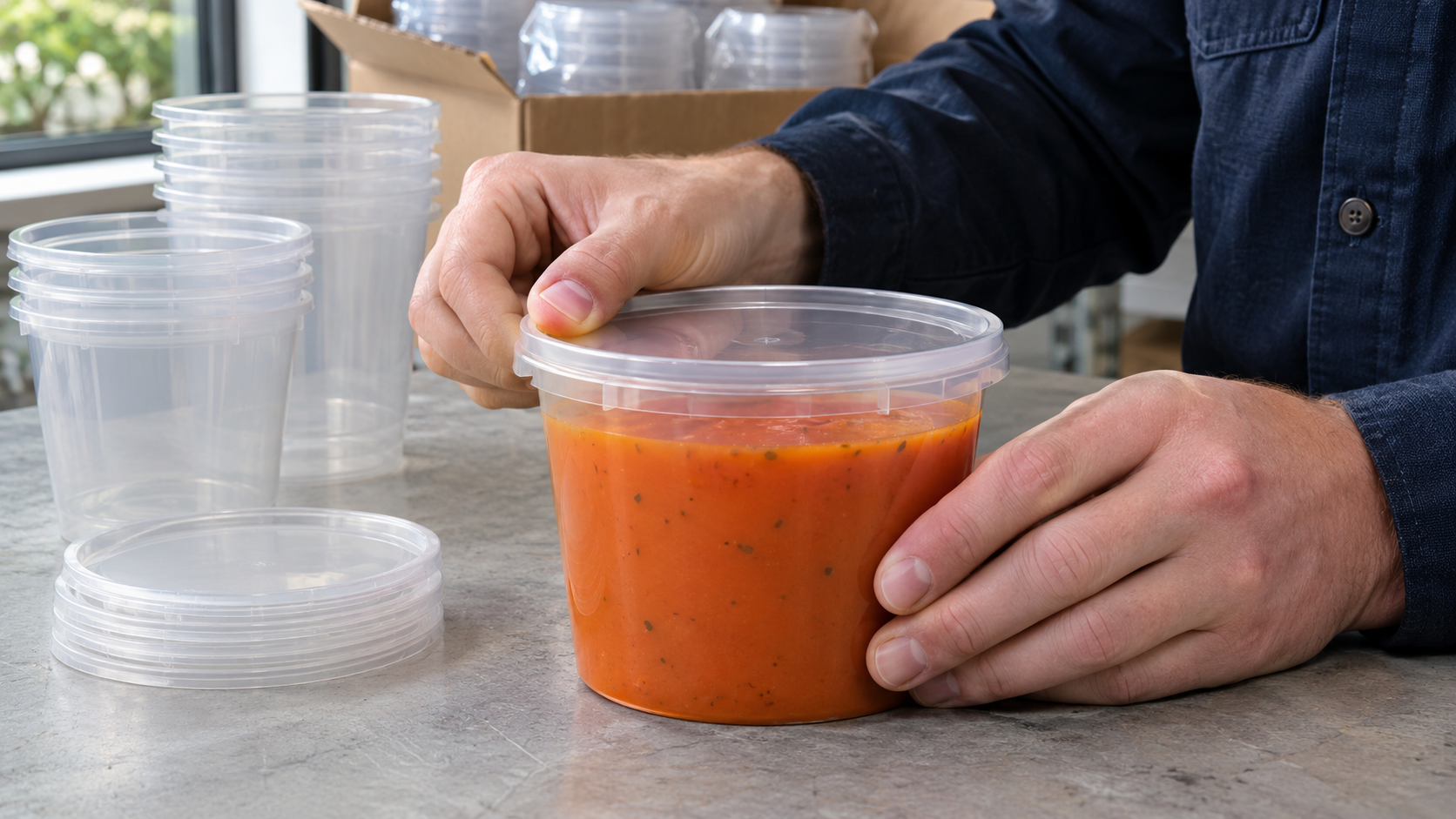
A plastic soup container has to survive a vigorous process and still look great when it’s sat on the retailer’s shelf or the consumer’s fridge. The pot has to work on the filling line, either with hot or cold contents, in a chiller, stacked on a pallet on the move and then transported around supermarkets and warehouses. It will then be popped in the microwave or into the freezer.
Choosing the wrong container type in this situation can lead to significant issues either during production or afterwards, damaging profits and the reputation of the brand. This guide looks at the requirements for good quality plastic soup containers and how to select the right supplier.
Choose your soup packaging here.
Selecting plastic pot shapes for chilled soups, sauces and dips
If you’re buying thousands of pots per year, by the pallet, then shape is as much about logistics practicality and efficiency as it is about aesthetics. Soup is a liquid, so the pot has to fill cleanly and empty cleanly for the consumer. The lid has to seal easily and cleanly to prevent damage, spills or breaks, but also for health and safety reasons while consumers are cooking. A good pot will combine all of these features with efficient distribution on the pallet, reducing lost space and the impact of logistics on product ROI.
For soup, which is a thin liquid in general, round pots are the most efficient. The product won’t get caught in the corners, and pots are easy to seal. They aren’t as efficient when packing on a pallet, as there will be gaps between each one, but this is the payoff for an excellent container for the product.
Sauces and dips are often thicker, which means they are more suitable for rectangular or square plastic containers. These use space better, which means you can unlock more economies of scale when shipping large volumes of units. On the shelf, square and rectangular pots fit more evenly, while round ones can be more eye-catching, but at the cost of fewer units displayed to the consumer.
Venturepak’s round pots start at 30ml, and we offer up to 1 litre before they become buckets, while rectangular and square pots and lids start at 125ml (square) with a variety of depths for gourmet dips and sauces. We also offer bucket sizes in both square and round for catering quantity and wholesale volumes.
Our wide range of sizes and shapes means you have options for full product categories, with catering and wholesale at one end of the spectrum and retailer, consumer or boutique options for your premium products. All of our pots and tubs can be branded through our in-mould labelling service.
Testing and trialling to find the right pot for your product
Soups, unlike many other food products, move inside the package when it’s in transit. If you have 25 1-litre pots of soup on a pallet, in a stack of 10 pallets, your transport now has roughly 250 kg of mass subject to gravity on your lorries or vans.
Your pots will need to have a strong seal on the lid and walls that are resistant to knocks, scrapes and minor impacts. The manufacturing quality of the pots also needs to be consistent, with a high-quality standard to ensure your products reach the customer in excellent condition.
Venturepak can provide samples for any pots you’re interested in, and this means you can trial-fill them and test how robust they are when being transported.
If you require samples, click here to speak to our team.
What temperature will you fill your soup packaging at?
There are two common ways to fill pots on the production line: either chilled fill or hot fill. Chilled fill is packaged cold, and the requirements on the plastic are limited to cooking recommendations for the customer. The volume injected into each pot is also consistent, as the temperature will remain roughly the same throughout the lifespan of the product. If you decide to freeze the soup, sauce or dip ready for long-distance transportation or for convenience for the customer, then the pot will need to be resistant to very low temperatures and accommodate the expanding volume of the soup as it freezes.
Hot-filled soup pots require the plastic in the packaging to be tolerant to high temperatures. The volume you fill the pot with also has to be considered, as it will shrink as it cools; you will need to buy a larger pot for hot-fill to accommodate the expanded volume in production.
Make sure you inform your packaging supplier about whether you plan to hot-fill or cold-fill your pots, and also let them know what the cooking and storage process will be for the soup. They can then source a plastic tolerance that allows for very cold and very hot temperatures, plus microwave-safe usage.
Speak to our team here, and we can help you source the right material for your soup, sauce or dip pots.
What to ask your supplier before ordering your soup, sauce or dip pots
The right supplier is one who can support your production processes in the long term, forming a partnership to ensure your product is packaged in the most efficient, secure and cost-effective way. Quantity breaks, call-off options and delivery lead times are all important factors to consider when selecting a new supplier.
Ask us the following questions:
- How are your pots packed and palletised? If you know how many pots fit on a pallet or in a lorry, then you can plan accordingly for your manufacturing line.
- Can we increase or decrease regular orders based on seasonality? Winter is soup season, so getting the stock ready in the Summer and Autumn will require more pots than during the low season in the Spring.
- Can you provide support with branding and labelling for our packaging? In-mould labelling and other labelling options will ensure your product is ready to go as soon as it is filled, rather than adding another business or step in the chain.
- Can you provide samples of a range of pots and containers so we can test and find the right ones? Being able to sample the product first will ensure everything goes smoothly during the order process.
- Can you manufacture and deliver to scheduled call times? Being able to manage the quantity of pots arriving at your warehouse will help manage precious storage space and prevent pots from becoming damaged or dirty while they are waiting to be used.
Call us and ask us the questions – we’ll be happy to provide a tailored quote.
Plastic Soup, Sauce and Dip Containers and Pots: Frequently Asked Questions
What labelling options are available for soup, sauce or dip pots and containers?
In Mould Labelling, where the label is part of the packaging, is an excellent branding solution for soups, dips and sauces. It’s a robust labelling method and will stand up well to transport, freezing and display. Find out more about IML here.
Are your soup pots tamper-evident?
Venturepak pots are all tamper-evident, making it easy for everyone in the supply and retail chain to see when a container has been compromised and needs to be replaced.
How should I plan for large soup pot orders?
Start by letting us know roughly the quantities you need on average and which parts of the year are your peaks and troughs. Also tell us what your lead times are from production to retail delivery. We can then work together to create a manufacturing schedule that marries our plastic pot production to your soup processes. This should ensure that we are working to one timetable and your soup can be sold seamlessly.